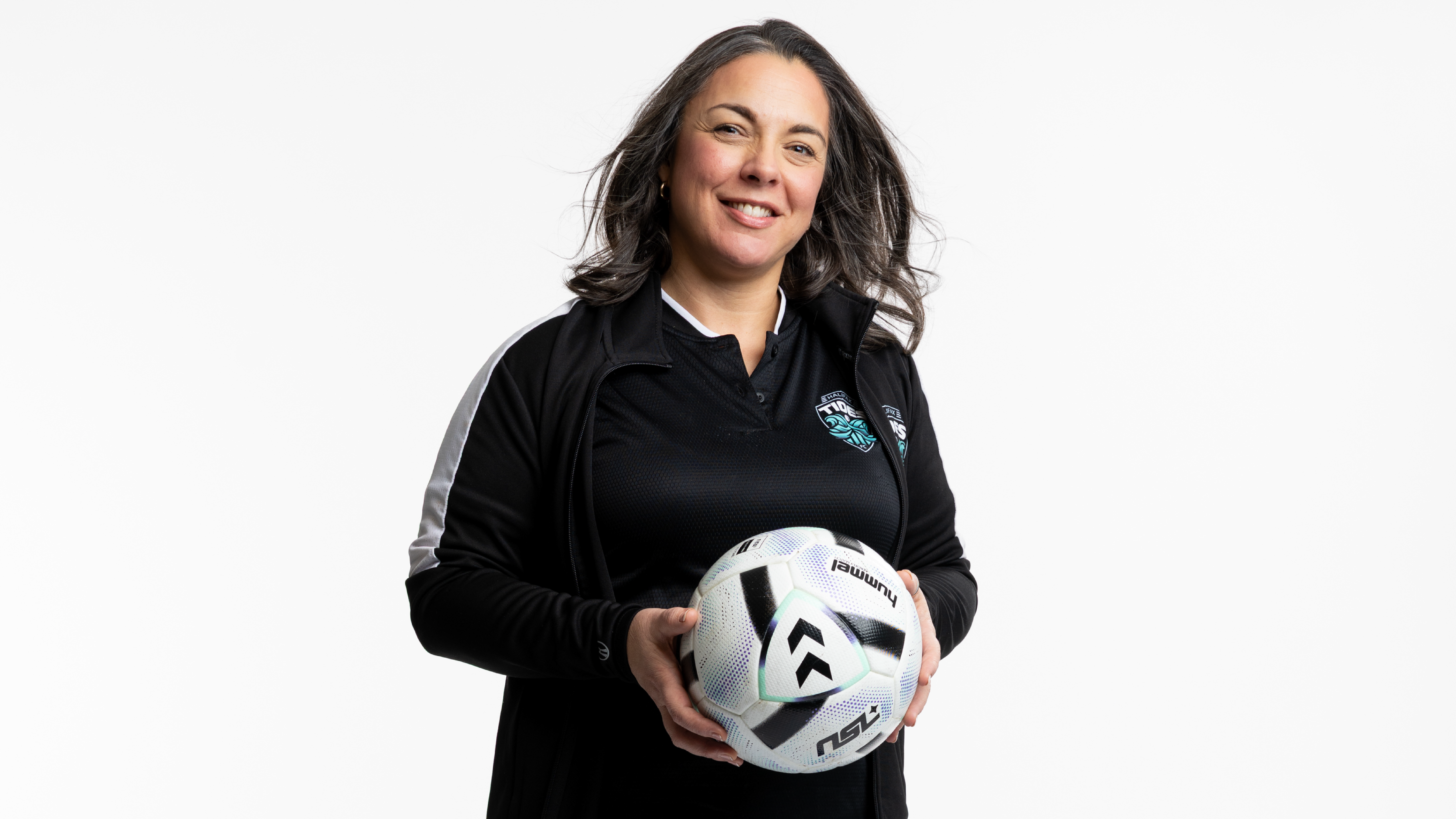
For International Women’s Day 2026, the theme “Give to Gain” is about the ripple effect of generosity, mentorship, and leadership. Val Malone, president of Halifax Tides FC, knows how giving time and guidance can change lives and entire communities. From boardrooms to the pitch, she’s seen firsthand how sport can shape confidence, leadership, and ambition. We spoke with her about the state of women’s sport, the power of mentorship, and how bold, visionary leadership can open doors far beyond the field.
You’ve led across industries–what does great leadership look like specifically in women’s sport right now?
Great leadership in women’s sport right now is both competitive and courageous.
Across every industry I’ve worked in, professional sport and its impact on the community has been the connective tissue. Through that work, I was introduced to a troubling reality: adolescent girls are dropping out of organized sport at alarming rates. When girls leave sport, they don’t just leave the field they lose access to the development of leadership, teamwork, confidence, and resilience.
At the same time, 94% of women in C-suite positions have participated in sport. That statistic stopped me in my tracks. If sport is such a powerful pathway to leadership, then every girl who exits the system widens the future equity gap.
Great leadership in women’s sport today means refusing to accept that as inevitable.
It means building high-performance environments on the pitch while also building pathways off it. It means recognizing that professional women’s sport isn’t just entertainment, it’s infrastructure for equality. It means investing in systems that keep girls in the game long enough to discover their voice, their strength, and their leadership capacity. Leadership in this moment isn’t only about growing leagues and revenues, it’s about changing outcomes.
In women’s sport right now, great leadership looks like vision paired with responsibility. It’s about winning and making sure more girls get the chance to step onto the field in the first place.
Where has women’s sport made the biggest leap–and where are we still underestimating what’s possible?
The biggest leap women’s sport has made is belief; from investors, broadcasters, sponsors, and most importantly, from fans.
For years, the narrative was that women’s sport was a “nice to have.” Today, we’re seeing record attendance, media rights deals, global brand investment, and genuine commercial momentum. The conversation has shifted from charity to opportunity. That’s a profound leap. We’re no longer proving women can compete, we're proving women’s sport is valuable.
Where we’re still underestimating what’s possible is in its broader societal impact.
We talk a lot about revenue growth, valuations, and expansion and those are important but we often underestimate women’s sport as a cultural and economic engine for equity. When girls see professional pathways, when they have access to sustained participation, when communities rally around women’s teams, the ripple effects go far beyond sport.
We’re also underestimating the speed at which this can scale if we build intentionally. If we invest in infrastructure, storytelling, grassroots systems, and leadership development with the same seriousness we’ve historically given men’s sport, the ceiling is far higher than most forecasts suggest.
Women’s sport isn’t emerging. It’s accelerating. The question isn’t whether it can grow, it’s whether we’re bold enough to match its ambition.
What do you hope young women in Atlantic Canada see when they look at this club?
I hope young women in Atlantic Canada see proof.
Proof that elite sport belongs here.
Proof that leadership can look like them.
Proof that ambition doesn’t require leaving home.
For too long, girls in our region have had to look elsewhere to see professional opportunity at the highest level. When they look at this club, I hope they see a viable pathway not just to play, but to lead, to work in sport, to build businesses, to shape culture.
I also hope they see standards.
That we train hard. That we compete relentlessly. That we expect excellence. Because visibility is important, but credibility is transformative. When young women see high performance executed with professionalism and pride, it expands what they believe is possible for themselves.
And beyond the pitch, I hope they see community; fans filling the stands, families investing emotionally, sponsors standing behind women’s sport not as a gesture, but as a growth strategy.
If they look at this club and think, “There’s a place for me here on the field, in the front office, in the boardroom, or in the stands,” then we’re doing our job.
Because what we’re building isn’t just a team. It’s a signal.
Why is it important to support other women and girls in sport?
Sport is a proven pathway to leadership, confidence, and resilience. Yet we know that girls drop out at alarming rates during adolescence. Every girl who leaves early is a voice, a talent, and a future leader lost. When we lift women and girls in sport, we’re not just creating athletes we’re creating leaders, problem-solvers, and role models.
It’s also about visibility. When young girls see women thriving on the field, in the front office, and in leadership positions, they expand what they believe is possible for themselves. That ripple effect can transform communities.
Supporting each other builds momentum. Women have historically had to carve space for themselves. When we actively support one another, we accelerate progress, we close gaps, and we create a culture where talent and ambition can flourish for every girl, everywhere.
One way a young girl can give–time, support, or encouragement–that will help her and others grow?
One of the simplest but most powerful ways a young girl can give is through encouragement.
Cheering for a teammate, mentoring a younger player, supporting women and girls in sport, or simply celebrating someone else’s effort builds confidence not just for them, but for herself. Giving encouragement teaches empathy, strengthens relationships, and creates a culture where everyone feels capable of taking risks and growing.
In sport and in life, the small acts of support you offer ripple far beyond the moment and in lifting others, you lift yourself too.
What message would you give to young women about the power of giving as they pursue their dreams?
I would tell young women that giving is not a detour from your ambition, it’s a multiplier.
There’s a myth that you have to choose between building your own success and lifting others along the way. In my experience, the opposite is true. The moments that have most shaped my career weren’t just about personal achievement, they were about investing in something bigger than myself.
Sport taught me that. Teams win because players contribute. Leaders rise because others trust them. Impact scales because people decide to give their time, their mentorship, their platform, their belief.
When you give, you build community. When you build community, you build opportunities for others and for yourself.
So pursue your dreams relentlessly. Compete. Lead. Be ambitious. But don’t underestimate the power of pulling someone else forward as you climb. The rooms you enter will feel less intimidating when you’ve already made space for others in them.
Legacy isn’t just what you accomplish. It’s who gets to go further because you were there.
And that’s real power.